Event
The Cloud is Heavy: Reimagining the Data Center Frontier
The “cloud” might be the most successful marketing heist of the 21st century. It’s a name that conjures images of ethereal, weightless wisps drifting lazily through a summer sky. In reality, the cloud is a massive, resource-hungry physical manifesto of power, built out of heavy concrete, high-performance silicon, and enough steel anchor the digital ambitions of an entire generation. As journalist Misha Glenny puts it, we’re in a “race to control the world,” and the finish line is being built out of data centers. Within the commercial sector, this typology is no longer a niche infrastructure play; data center projects are growing at an exponential rate, rapidly becoming a dominant force in real estate development and urban planning.
For a long time, these buildings were stealth in the built world: windowless boxes tucked away in remote deserts where they couldn’t bother anyone. But as AI demands more speed and less lag, data centers are moving into our cities, our neighborhoods, and potentially in near future, our pockets. This shift is forcing a radical reimagining of this typology and pushes us to think what our job should be.
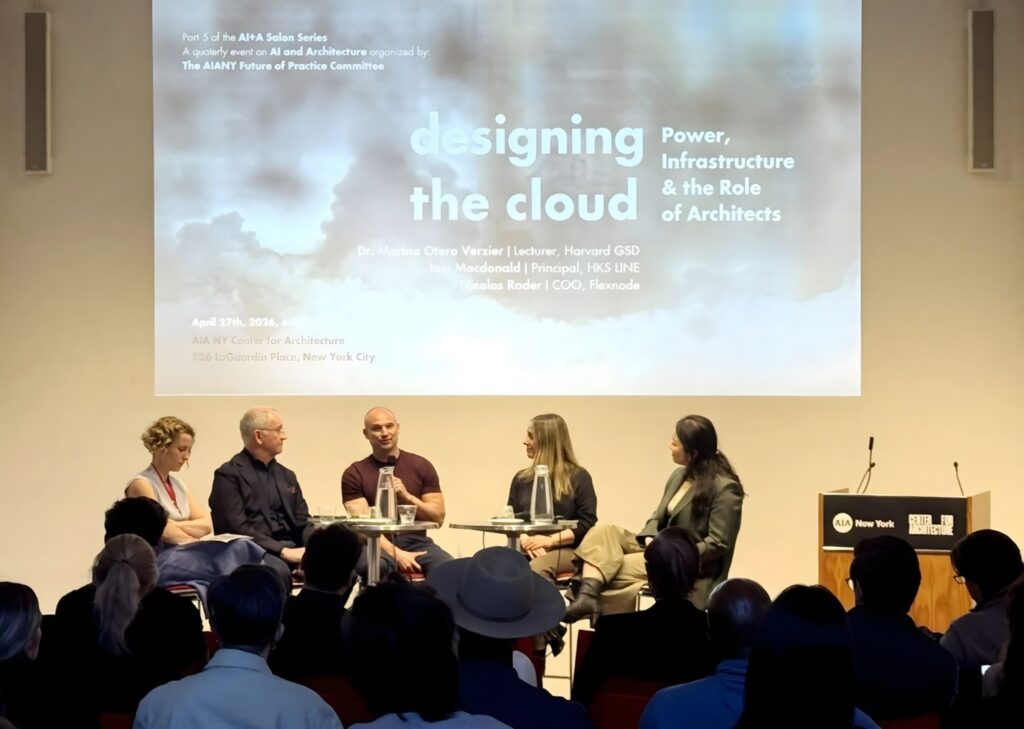
I recently sat down to co-moderate a panel for the AI+A Salon Series, “Designing the Cloud,” alongside Xenia Adjoubei Kwan. We brought in the heavy hitters: researcher Dr. Marina Otero Verzier, entrepreneur Nic Rader, and Iain Macdonald, a veteran of energy infrastructure who has probably forgotten more about power grids than I’ll ever know. We weren’t just there to geek out over liquid cooling and massive floor loads (though, let’s be honest, we did a little of that). We were there to figure out if architects are going to design the future or just pick the paint colors for the boxes the engineers build.
The first path forward is what we call “Urban Metabolism,” which sounds like a trendy diet but as many architects learned in school, is derived from the post-war Japanese movement. If we need “edge” data centers in our cities to keep our chatbot react instantly, we have to stop hiding them like shameful secrets. We need to move past 20th-century zoning and embrace resource circularity. Imagine a data center that doesn’t just “waste” heat but acts as a giant radiator for the neighborhood—warming up the local swimming pool, powering greenhouses, or heating district housing.
Of course, there’s a hilarious temporal mismatch here: tech moves at the speed of light, with chips upgrading every three years, while buildings are expected to stand for decades. We need infrastructure that is as adaptive as a Lego set – modular, reusable, and highly compatible, similar to what Nic’s company Flexnode is developing. Iain even proposed using Small Modular Reactors (SMRs) to provide carbon-free power, allowing these “AI factories” to live in the heart of the city without turning the local grid into a pile of melted copper. However, Marina offered a sobering reality check: if we make our public showers dependent on server heat, we might find ourselves running the machines just to stay warm. It’s a classic case of the tail wagging the dog—or the server rack wagging the city.
This leads us to the more soul-searching question: the “Critical Path.” Do we actually need all this stuff? Currently, we live in a world of “Hot Data.” We demand that a blurry photo of a sandwich from 2014 be accessible in 0.001 seconds. This requires an insane amount of energy to keep servers shivering at 99.999% uptime.
One audience member hit us with an analogy that was as brilliant as it was depressing: our current data model is like using the Colorado River’s precious water to grow alfalfa for cattle—a massive expenditure of a finite resource for a very low-value output. Marina’s solution? A “Data Library” model. Keep the emergencies and bank transfers “Hot,” but put the memes and the 4,000 selfies into “Cold Storage.” It’s okay if it takes a minute to retrieve a photo of your cat from five years ago. The planet will thank you.
If architects want a seat at the table where the trillion-dollar tech giants sit, we have to stop being “facade decorators.” We have to learn the lingo. If you can’t talk about power loads and cooling cycles (the “MEP” of it all), you’re just the person picking the curtains while the engineers decide how the world actually works.
The cloud isn’t invisible anymore; it’s landing on our doorsteps, and it’s thirsty for water and power. We have a massive opportunity to design the systems that power our age, not just the shells that hide them. It’s time we ensure the infrastructure of the 21st century is as thoughtfully crafted as the devices we use to browse it. Otherwise, we’re just building the world’s most expensive radiators.