Insight
How to Design a Commercial Building for Aging in Place

Designing a commercial building that supports aging in place means thinking long-term. The goal is to create environments that remain functional and supportive as users’ physical abilities change. While the concept is often applied in residential settings, it is gaining relevance in a wider range of spaces where people spend significant time and remain engaged throughout different stages of life.
This approach begins with the understanding that buildings serve a broad and changing population. As people age, their physical abilities and ways of interacting with the environment gradually shift, affecting how they experience and navigate space. A design that accounts for those changes early on is more likely to remain useful over time.
Accessibility as a Starting Point
Making a building accessible is more than meeting code. It involves thinking through how someone experiences the space from arrival to departure. Entrances should be smooth and easy to reach.
Key features throughout the building should be located to support ease of movement and reduce strain. Everyday interactions, such as entering a room or taking a break, can either contribute to a sense of independence or become points of difficulty, depending on how they are designed. A well-designed building reduces those obstacles without drawing attention to them.
Design That Supports Navigation
Clear layout and wayfinding help reduce stress, especially as memory or vision changes with age. When circulation paths are intuitive, and spaces are logically connected, users can move through the building with greater confidence. This benefits everyone, but it becomes even more important as the ability to adapt quickly to new environments decreases.
The way a space is built and lit influences how easily people can understand their surroundings and find their way through it. These decisions influence how people feel in a place and how well they can navigate it without help.
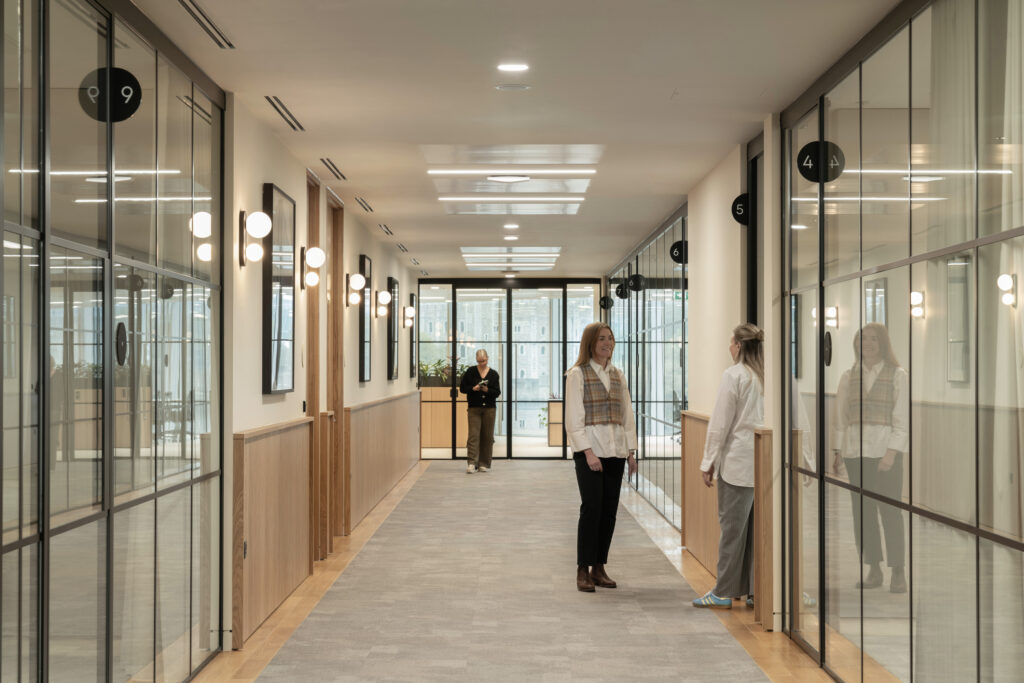
Hg Capital wayfinding program designed by HLW’s brandx team
Durability with Adaptability
A building that supports aging in place must also adapt over time. Over time, the building may need to adjust to new uses or evolving needs, which could mean rethinking layouts or integrating supportive features as conditions change. Planning for these possibilities early allows a space to grow without major reconstruction. How a building is put together affects its ability to respond to future needs. When adaptability is part of the design, the space can evolve more easily over time, helping it remain useful and economically viable.
Design That Lasts with People in Mind
A commercial building designed for aging in place becomes more than a place of business or gathering. It becomes a place that responds to the realities of aging while supporting continued engagement and autonomy. When design considers the full arc of life, the result is a space that remains meaningful.